 082-560489

Strategic Planning, Way Forward and Progress Review Workshop
27 July 2026, Dang Ghorahi:
1. General Information
Organized by:
Aatmanirbhar Laghubitta Bittiya Sanstha Limited
Program Title:
Strategic Planning: Way Forward and FY 2082/083 Progress Review Workshop
Dates and Venues:
- First Cluster: July 25, 2026, at Malla Inn Hotel, Ghorahi
- Second Cluster: July 26, 2026, at Swastik Hotel and Resort, Banke
Chairperson:
Saugat Bir Chaudhary, Chief Executive Officer
Program Facilitator:
Kali Das Chaudhary, Head of the Human Resources Department
Lead Trainer for the SWOT Analysis Session:
Hit Bahadur Thapa, Consultant Trainer
2. Background
Aatmanirbhar Laghubitta Bittiya Sanstha Limited (ANLBS) organized a two-cluster workshop titled “Strategic Planning: Way Forward and FY 2082/083 Progress Review Workshop” on July 25 and 26, 2026.
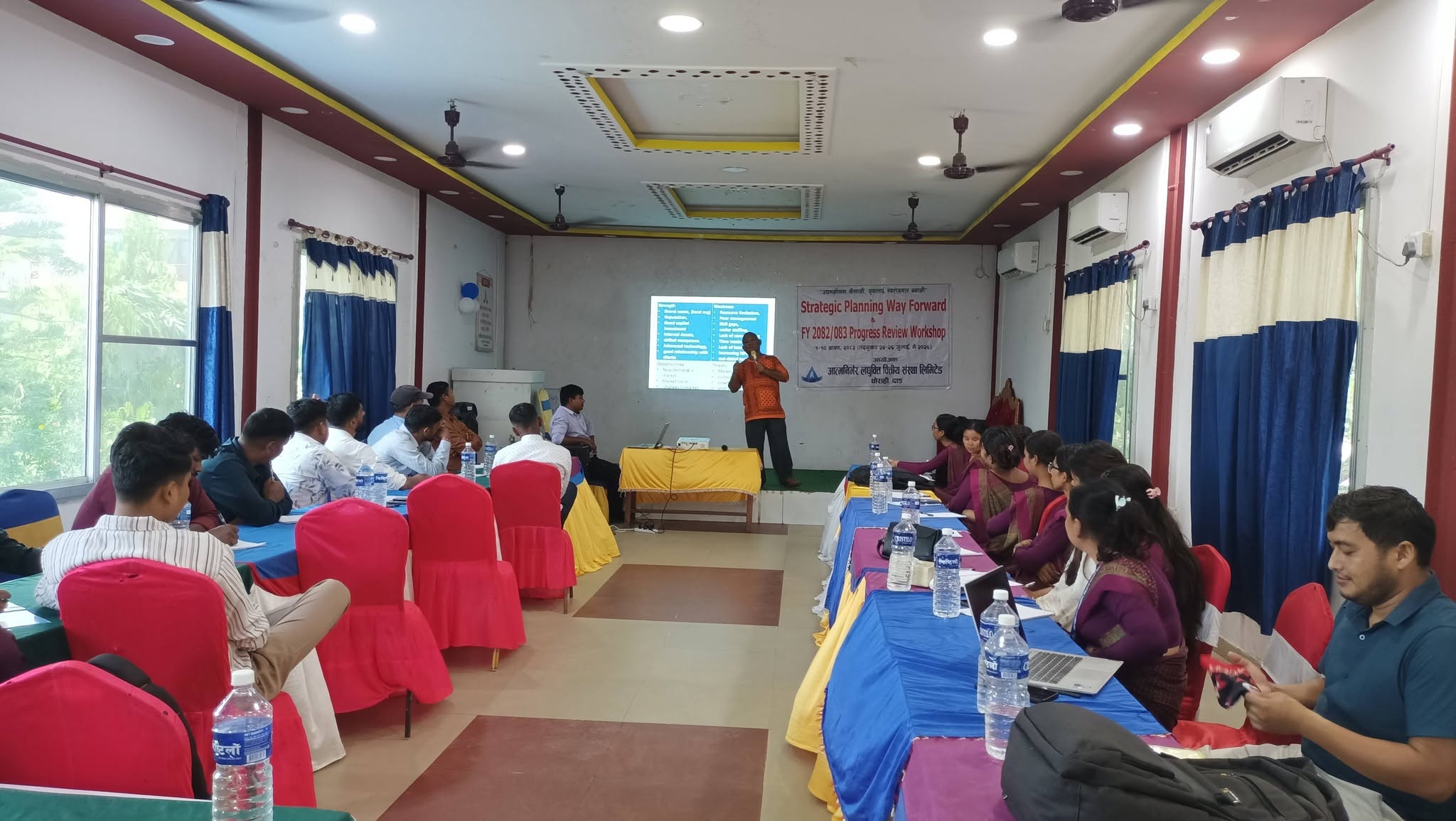
The first cluster Strategic planning review workshop was conducted at Malla Inn Hotel in Ghorahi on July 25, 2026, with around 70 staff participants while the second cluster review workshop was conducted at Swastik Hotel and Resort in Banke on July 26, 2026 with around 25 participants. The programs were organized to review the institution’s performance during the fiscal year 2082/083 and to formulate practical plans, strategies, and priorities for the upcoming fiscal year 2083/084.
Both programs were held under the chairmanship of the Chief Executive Officer of the ANLBS, Saugat Bir Chaudhary. The workshops brought together management personnel, departmental representatives, branch-level staff, trainers, and other concerned officials of the institution.
The two-cluster arrangement provided an opportunity for staff members from different operational areas to participate conveniently, review their 21 branch wise respective performances, identify institutional challenges, and contribute to the preparation of the institution’s future strategic direction.
3. Objectives of the Workshop
The major objectives of the workshop were:
- To review the overall performance and progress of the institution during fiscal year 2082/083.
- To assess the achievements of different departments, branches, and operational units against their annual targets.
- To identify major operational, financial, institutional, and human-resource-related challenges.
- To analyze the internal strengths and weaknesses of Aatmanirbhar Laghubitta Bittiya Sanstha Limited.
- To identify external opportunities and threats affecting the institution.
- To develop strategies and action plans for fiscal year 2083/084.
- To strengthen coordination among the central office, departments, branches, and field-level staff.
- To improve institutional effectiveness, portfolio quality, member services, financial sustainability, and staff performance.
- To establish a clear way forward for the sustainable growth and development of the institution.
4. Opening Session
The workshop at Mala Inn in Ghorahi on July 25,2026 began with a welcome address delivered by the institution’s Senior Manager, Ms. Sushila Giri. In her remarks, she welcomed the chairperson, trainers, participants, and other officials attending the program.
She highlighted the importance of periodically reviewing institutional performance and preparing realistic strategies for the future. She emphasized that the workshop would support the institution in identifying its achievements, recognizing existing challenges, and establishing clear priorities for the forthcoming fiscal year.
The program was chaired by Saugat Bir Chaudhary, Chief Executive Officer of ANLBS. In his opening remarks, the Chief Executive Officer stressed the importance of teamwork, accountability, effective implementation, and result-oriented planning.
He noted that strategic planning should not remain limited to the preparation of documents. Instead, the strategies and commitments developed during the workshop should be translated into practical actions at the departmental, branch, and field levels.
The overall program was facilitated by Kali Das Chaudhary, Head of the Human Resources Department. He coordinated the different sessions, managed the flow of presentations and discussions, and encouraged active participation from all participants.
A major component of the workshop was the review of the institution’s performance during fiscal year 2082/083. The participants examined the progress achieved by the institution in relation to its annual plans, targets, programs, and operational responsibilities.
The review covered different areas of institutional performance, including:
- Expansion and strengthening of member services
- Savings mobilization
- Loan disbursement and recovery
- Portfolio quality
- Management of overdue loans and non-performing loans
- Branch performance
- Centre management
- Financial literacy activities
- Entrepreneurship development
- Staff performance and capacity
- Internal coordination
- Institutional governance
- Administrative efficiency
- Risk management
- Financial sustainability
- Community outreach
- Compliance with institutional policies and regulatory requirements
The review sessions enabled the participants to compare planned targets with actual achievements. Successful activities and good practices were identified, while areas where progress remained below expectations were also discussed.
Branch-level and departmental experiences were shared to help the institution understand the practical challenges faced during program implementation. Participants discussed problems related to loan recovery, member discipline, operational costs, staff workload, competition, documentation, communication, and the changing economic situation.
The discussions emphasized the need for regular monitoring, timely corrective action, improved staff accountability, stronger field supervision, and better communication between the central office and branch offices.
6. SWOT Analysis of Aatmanirbhar Laghubita Bittiya Sanstha Ltd
One of the major technical sessions of the workshop was the SWOT analysis of ANLBS. The session was delivered by the consultant trainer- Hit Bahadur Thapa. The session focused on identifying the institution’s internal strengths and weaknesses as well as the external opportunities and threats that could influence its future performance. The participants were encouraged to analyse the institution realistically and propose practical measures for improvement.
6.1 Strengths
The major strengths identified during the workshop included:
- A good reputation and brand name of ANBLS
- ANBLS share being on the top of NEPSE
- Good assets
- A strong institutional presence in the working areas in lumbini.
- An established network of branches, centres, and members
- Committed and experienced management
- Dedicated and hardworking staff members
- Staff members who understand local languages and communities
- Strong relationships with women, low-income households, and rural communities
- Experience in microfinance services and community mobilization
- A recognized institutional identity and public trust
- Availability of institutional assets and operational infrastructure
- A large base of 37000 plus and 12000 plus borrowers
- Experience in conducting financial literacy and entrepreneurship development programs
- Strong community-based approaches and centre-level structures
- Commitment to women’s empowerment and economic self-reliance
- Support from the central office and senior management
- Capacity to reach communities that have limited access to formal banking services
The trainer explained that these strengths should be used more effectively to improve the institution’s competitiveness, service quality, portfolio performance, and long-term sustainability.
6.2 Weaknesses
The participants also identified several internal weaknesses that require management attention, including:
- A relatively certain level of overdue and non-performing loans
- Gaps in follow-up and loan recovery
- Limited adoption of technology in some operational areas
- Differences in staff skills and performance levels
- Need for stronger internal control and accountability mechanisms
- Instability of staff
- Female staff still under the influence of patriarchal norms.
The workshop emphasized that weaknesses should not be treated merely as problems. They should be used as a basis for preparing targeted improvement plans, staff development programs, stronger monitoring mechanisms, and realistic performance standards.
6.3 Opportunities
The major external opportunities identified during the SWOT analysis included:
- Increasing demand for accessible financial services in rural and semi-urban communities
- Opportunities to expand digital and technology-based services
- Growing interest in entrepreneurship and self-employment
- Opportunities to provide financial literacy and business development services
- Possibility of designing products for agriculture, livestock, small enterprises, youth, and women entrepreneurs
- Expansion into underserved communities
- Opportunities to improve institutional visibility through successful member stories and community programs
- Potential to strengthen savings products and responsible credit services
- Possibility of introducing more demand-based financial products
- Opportunities for staff capacity development and professional training
- Use of data and technology to improve decision-making and operational efficiency
The trainer encouraged the institution to develop appropriate products and partnerships to take advantage of these opportunities without compromising financial discipline and institutional sustainability.
6.4 Threats
The major external threats discussed during the workshop included:
- Increasing competition among other microfinance institutions.
- Economic fluctuations
- Economic downturn
- Negative public perceptions regarding microfinance services
- Changes in government policies and regulatory requirements
- Political and social pressure affecting loan recovery
- Natural disasters, climate-related risks, and agricultural losses
- Migration of economically active people
- Increasing operational and administrative costs
- Cybersecurity and data-security risks
- Changing behaviour of members
The participants discussed the importance of preparing risk-mitigation measures and maintaining flexibility in institutional planning. The need for responsible lending, accurate credit appraisal, strong member communication, staff discipline, regulatory compliance, and effective risk management was strongly emphasized.
Following the performance review and SWOT analysis, the participants discussed the institution’s priorities for fiscal year 2083/084. Plans and strategies were prepared to address existing weaknesses, manage external threats, utilize available opportunities, and build upon institutional strengths.
The strategic priorities discussed during the workshop included:
6.5 Improvement of Portfolio Quality
The institution should give high priority to reducing overdue loans and non-performing loans. Branches should prepare borrower-wise recovery plans and regularly monitor repayment performance.
Loan utilization should be verified through field visits, and early warning signs should be identified before accounts become seriously overdue. The institution should maintain a balance between portfolio growth and portfolio quality.
6.6 Strengthening Credit Appraisal
The loan appraisal process should be strengthened to ensure that loans are provided according to the actual repayment capacity and business needs of borrowers.
Staff should carefully assess household income, existing debt obligations, business feasibility, cash flow, credit history, and possible risks before recommending loans. Multiple borrowing and over-indebtedness should be monitored carefully.
6.6 Strengthening Branch and Centre Management
Branches and centres should be regularly monitored based on clear performance indicators. Weak branches and centres should receive special technical support, supervision, and follow-up.
Regular centre meetings, member education, savings discipline, loan repayment, and communication with members should be improved. Best-performing branches and centres should be recognized and their good practices replicated.
6.7. Human Resource Development
Regular training should be provided to staff members on credit appraisal, recovery management, customer service, financial literacy, digital systems, communication, leadership, reporting, and regulatory compliance.
A transparent performance evaluation system should be maintained. Staff motivation, career development, recognition, teamwork, and accountability should be strengthened.
6.8 Digitalization and Data Management
The institution should gradually expand the use of digital tools in data collection, reporting, monitoring, communication, and service delivery.
Management decisions should be based on timely and accurate data. Staff should be trained to use digital systems properly while maintaining data confidentiality and cybersecurity.
6.9. Member-Centred Services
Financial products and services should be designed according to the actual needs and capacities of members. The institution should provide clear information about loan conditions, repayment obligations, savings products, and available services.
Member complaints and suggestions should be handled promptly. Financial literacy, entrepreneurship development, and business-support services should be expanded.
8. Institutional Governance and Internal Control
Internal policies, procedures, reporting systems, and accountability mechanisms should be followed consistently.
Regular internal monitoring and audits should be conducted to identify irregularities, operational risks, and compliance gaps. Roles and responsibilities should be clearly communicated to all staff members.
8.1. Training Sessions and Resource Persons
The workshop included presentations, technical sessions, group discussions, performance reviews, and strategic planning exercises.
The training and facilitation sessions were conducted by the following officials and resource persons:
- Mr. Saugat Bir Chaudhary, Chief Executive Officer
- Mr. Hit Bahadur Thapa, Consultant
- Mr. Nirmal Chaudhary A
- Mr. Kali Das Chaudhary
- Mr. Binaya Chaudhary
- Ms. Sushila Giri
- Mr. Nep Bahadur Chaudhary
- Mr. Nirmal Chaudhary B.
- Ms. Puja Gharti Magar
- Other concerned trainers and officials of the institution
Mr. Hit Bahadur Thapa led the session on SWOT analysis and guided participants in assessing the institutional situation. He explained how the findings of a SWOT analysis could be converted into practical strategies and action plans.
The resource persons shared their knowledge and experiences in relation to institutional development, human resource management, operational performance, loan management, branch-level challenges, monitoring, and strategic planning.
The two-cluster approach allowed broader participation from staff members working in different geographical areas. It also helped the institution collect diverse perspectives and understands differences in branch-level conditions.
10. Major Outcomes of the Workshop
The major outcomes of the two-cluster workshop were as follows:
- The institution’s progress and performance for fiscal year 2082/083 were reviewed.
- Major achievements, gaps, and operational challenges were identified.
- A comprehensive SWOT analysis of Aatmanirbhar Laghubitta Bittiya Sanstha Limited was conducted.
- Participants developed a clearer understanding of the institution’s internal and external operating environment.
- Priority areas for fiscal year 2083/084 were identified.
- Strategies were discussed for improving loan recovery and reducing non-performing loans.
- The importance of responsible lending and effective credit appraisal was reinforced.
- The need for stronger monitoring, supervision, and staff accountability was recognized.
- Participants identified opportunities for digitalization, partnerships, and product development.
- Coordination among the central office, departments, branches, and field-level staff was strengthened.
- Staff members were encouraged to adopt a result-oriented and member-centred approach.
- A common understanding was developed regarding the institution’s future direction and priorities.
- The importance of translating strategic plans into measurable actions was emphasized.
- The workshop created a platform for participants to share practical challenges and possible solutions.
- Institutional commitment to sustainable growth, social impact, and financial discipline was renewed.
Prepared by: Hit Bahadur Thapa
Designation:Consultant Trainer for SWOT Analysis
Date of Submission: 27 July, 2026